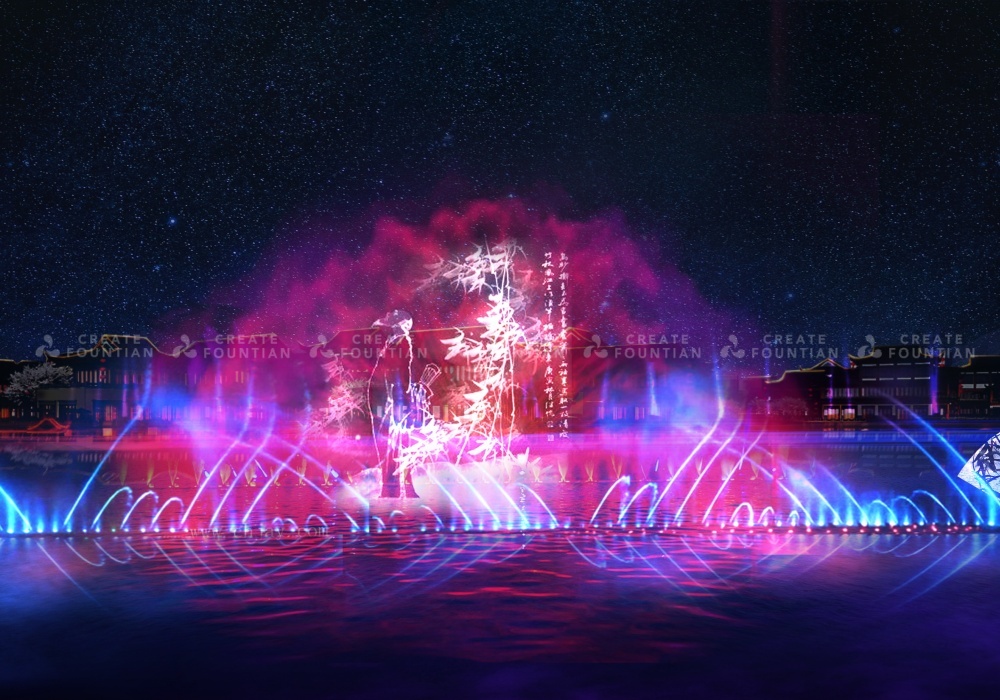
We are using the water screen as a semi-transparent, volumetric projection surface. The laser light scatters off the tiny water droplets, making the beam visible along its entire path through the screen. This allows for stunning 3D-like effects where graphics seem to float or emerge from the water.
Essential System Components
We need both a robust water screen system and a professional laser projection system.
Part 1: The Water Screen
* High-Pressure Mist/Fog Nozzles: Unlike a laminar sheet for video, laser shows often use a dense curtain of fine mist. This maximizes light scattering. Industrial fogger nozzles or high-pressure water jets (creating atomized mist) are used.
* Powerful Pump & Filtration: A high-pressure pump (500-1000+ PSI) is needed to create the fine mist. A water softener/filter is critical to prevent nozzle clogs from minerals.
* Frame & Reservoir: A rigid frame holds the nozzle array in a straight line. A large basin collects and recirculates the water.
* Wind Shield: Even a light breeze will distort a mist screen. Professional setups often have wind barriers or are used indoors.
Part 2: The Laser System
This is not a laser pointer. You need an ILDA-compatible graphics laser projector.
* Laser Projector: Contains RGB lasers (for full color), high-speed galvanometer scanners ("galvos") that draw the graphics, and control software.
* Power Requirement: For outdoor use against ambient light, you typically need >5 Watts of laser power. Indoor shows can use lower power (1-3W).
* Control Software & Hardware: You use software like Pangolin Beyond, LaserShow Designer, or Mamba to create/play back shows and control the laser via an ILDA cable.
* Safety System: Includes a remote interlock (kill switch) and must be set up to ensure beams terminate safely and never enter uncontrolled public airspace.
Part 3: Synchronization
* Audio Sync: The laser show software should be synced to a music track for a coordinated experience.
* Timing with Water: The water pump and laser need to start/stop together via a central show controller or manual cues.
Step-by-Step Setup Process
Step 1: Design & Safety First
1. Venue: Choose a controlled, low-wind environment. Indoors is ideal.
2. Safety Plan: This is the most critical step. You are combining high-power lasers (Class 3B/4) and water/electricity.
* Laser Safety Officer (LSO): Have a designated person.
* Eye Safety: Never scan the audience. Ensure the laser beams are always contained within the "screen zone" and terminate safely. Use laser safety goggles during setup.
* Electrical Safety: All equipment must be on GFCI circuits, and connections must be waterproofed.
* Permissions: For public displays, you often need variance permits from your local radiation/food & drug authority (like the FDA in the US).
Step 2: Assemble the Water Screen
1. Position the reservoir basin.
2. Mount the nozzle frame securely above it, ensuring it's perfectly level.
3. Connect the high-pressure pump (placed in the basin) to the nozzles with high-pressure hose.
4. Fill the basin, add filtered/softened water, and test the mist curtain. Adjust until you have a uniform, dense, and tall screen.
Step 3: Position and Align the Laser
1. Place the laser projector on a stable, vibration-free platform. Tripods work.
2. Position it for front projection (laser and audience on the same side) or, less commonly, rear projection.
3. Crucial Alignment: Using the laser's alignment software, project a simple test pattern (like a square). Manually aim and focus the laser so the entire graphic fits perfectly within the bounds of the water screen. The focal plane should be on the screen.
Step 4: Program the Laser Show
1. In your laser software (e.g., Pangolin Beyond), create or load your graphics and animations.
2. Design effects that play to the medium's strengths: logos materializing, 3D tunnels, particles flowing with the water, etc.
3. Sync the show timeline to your chosen audio track.
Step 5: Run the Integrated Show
1. Clear the area of non-essential personnel. Everyone remaining should know safety procedures.
2. Start the water pump and confirm a stable mist screen.
3. Enable the laser's safety interlock.
4. Start the audio track and launch the laser show from your computer.
For events held irregularly (such as weddings, product launches, and festival celebrations), the most practical and safest approach is to hire a professional audiovisual or special effects company, especially those specializing in laser and water screen performances.
Choose Jiangsu Create Water Environment Technology co.,ltd. we provide high-end, reliable screen equipment, safety certifications, and professional technology to create stunning effects for you.
You may like: Floating Musical Fountain,Dry Floor Musical Fountain,Interactive Musical Fountain